5.5 times the power of the most powerful road-going car Bugatti Veyron Super.
It will take the ESSνSB Super Beam proton pulse 1.8 ms=0.0018 seconds to reach the far detector if located at 540 km distance from ESS (Garpenberg mine) or 1.2ms=0.0012 seconds if located at 360km (Zinkgruvan mine).
Image by Pete Linforth on Pixabay
ESSνSB Far Detector will be built 1km underground which is at a depth of about 3 times the height of the Eiffel Tower.
Picture by Gerd Altmann on Pixabay
The ESS Linear Accelerator (Linac) is 490m long which represents around 4.7 times the length of a soccer field.
Picture by Garik Barseghyan on Pixabay
ESSνSB Far Detector will contain 1 000 000 000 litres of water which represents a volume equal to that of a cube 100 m high and with a 100 m x 100 m bottom surface and is twice the volume that can be carried by the world largest super-tanker (TI Europe)
Picture by Kai Kalhh on Pixabay
ESSνSB is the world's most intense neutrino beam project.
Picture by Media Design and Media Publishing on Pixabay
What are neutrinos?
Picture by Gerd Altmann on Pixabay
The lightest fundamental particle.
Neutrinos are elusive and difficult to detect.
Picture by Gerd Altmann on Pixabay
Neutrinos are plentiful: they come from everywhere, from the sun, from the earth, from supernovae and from the Big Bang.
Image by Barbara A. Lane on Pixabay
Neutrinos travel as fast as light (almost!)
Picture by Public Domain Pictures on Pixabay
Neutrinos have three different flavours: Electron, Muon, Tau.
Picture by Gerd Altmann on Pixabay
Without the asymmetry between Matter and Antimatter we would not exist. How this symmetry was broken is an outstanding question?
Picture by Gerd Altmann of Pixabay
ESSνSB will study this question.
The years of major neutrino discoveries and years when those discoveries were awarded the Nobel Prizes:
Picture by Gerd Altmann on Pixabay
Pauli 1930/1945 : Prediction of neutrino
Cowan & Reines 1956/1995: Discovery of neutrino.
Davis & Koshiba 1987/2002: Solar & cosmic neutrinos.
ESSνSB Timeline and funding obtained (till 2017) or required (as of 2022):
Picture by Gerd Altmann on Pixabay
2015: Concept (2M€)
2019: Initial Design (5M€)
2022: Final Design (10M€)
2025: Construction of Detector (550M€)
2028: Construction of Neutrino Source (650M€)
2035-2085: Operational phase
2012: First ideas
There were equal quantities of Matter and Antimatter created in the Big Bang.
Image by Douglas James on Pixabay
But there is no antimatter in the Universe now. Why?
Advantages of ESSνSB Project:
Image by Douglas James on Pixabay
- Hightest production intensity (5MW proton driver);
- Largest detector (1 million tonnes of water);
- Greatest sensitivity (measures at the 2nd neutrino oscillation maximum).
Picture by Wikilmages on Pixabay
In ESSνSB project, a single beam pulse has the same energy as a 7.2kg bullet traveling at 1100 km/hour or, differently expressed, has the same kinetic energy as a 1000 kg car traveling at nearly 100 km/hour or the same heat energy it takes to melt 1000 kg of ice.
Picture by Wikilmages on Pixabay
In the ESSνSB project, the duration of a super beam pulse will be 3 ms which means that there will be a distance of 900km (distance between Roma in Italy and Geneva in Switzerland) between the first and the last proton of the beam pulse.
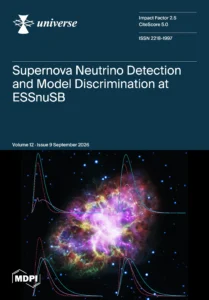
Cover Story : This study evaluates the sensitivity of the proposed ESSnuSBfar detector—a 538 kt water Cherenkov detector in Sweden—to supernova neutrinos. While optimized for leptonic CP violation, its massive volume provides excellent potential for detecting core-collapse supernova bursts. We simulate expected inverse beta decay event rates across three prominent supernova flux models (Livermore, GVKM, and Garching) and evaluate the detector’s ability to differentiate between them. Factoring in systematic errors, detector efficiencies, and energy resolution, the results demonstrate that the ESSnuSBfar detector can successfully discriminate between distinct flux models for a Galactic or near-Galactic supernova, offering a vital tool for advancing neutrino physics and core-collapse astrophysics.
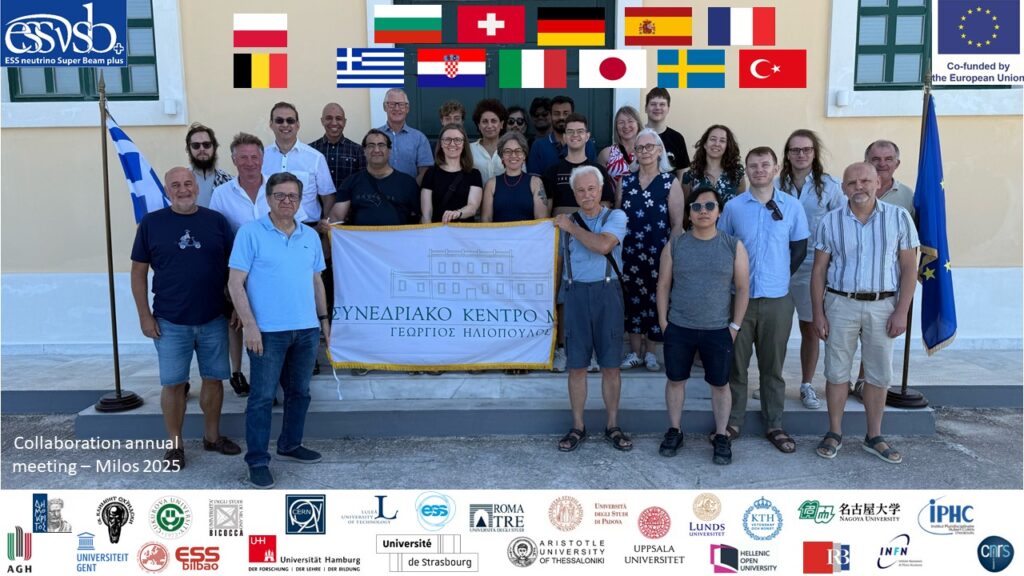
was organised by Collaboration members and held
on 29 June- 11 July 2025
at the Faculty of Physics and Engineering of the University of Strasbourg, France.
The new proposal, ESSnuSB+, submitted to the EU in April 2022, was approved in July 2022.
Objectives and Ambitions of the new project :
The key objective of the H2020 ESSνSB Design Study was to demonstrate the feasibility of using the European Spallation Source proton linac to produce the world’s most intense neutrino beam concurrently with the 5 MW proton beam that will be used for the production of spallation neutrons. After the production of all deliverables and the publication of the ESSνSB CDR, this is now accomplished. The present Design Study is proposed to pave the way of ESSνSB by introducing complementary studies and enlarging its scope by introducing investigations of synergetic projects. The ESSνSB+ strategic objectives are: 1) Make all necessary civil engineering and geotechnical studies needed for the facility implementation of the ESSνSB/ESSνSB+ technical facilities at the ESS site and at the far detector side. 2) Study the implementation of a special target station for pion production and extraction for injection to a Low Energy nuSTORM decay ring and Low Energy Monitored Neutrino Beam decay tunnel. 3) Study the Low Energy nuSTORM decay ring and the injection of pions and muons coming from the special target station. 4) Study the Low Energy Monitored Neutrino Beam instrumented decay tunnel and the injection of pions coming from the special target station. 5) Study the design of a common detector for the Low Energy nuSTORM and for the Low Energy Monitored Neutrino Beam sub-projects for measurement of the neutrino cross-sections of interest. 6) Investigate the possibility of the utilisation of the Low Energy nuSTORM with its near detector and the ESSνSB near detector, already designed, for sterile neutrino searches. 7) Carry out studies of the geotechnical characteristics of the currently preferred site at Zinkgruvan for the underground ESSνSB far detector and study its potential for astroparticle physics programme. 8) Promote the ESSνSB/ESSνSB+ projects to their stakeholders, including scientists, politicians, funders, industrialists and the general public in order to have it included in the ESFRI list, which will allow to carry out extensive R&D work leading to a Technical Design Report for the whole facility.